What Should a 2027 CHRO Job Description Actually Include?
Updated: 6 days ago
Gartner published its CHRO priorities report for 2026 in October 2025. The headline finding was direct: CHROs' top priorities now center on realizing AI value and driving performance amid uncertainty. Not compliance. Not benefits administration. Not talent acquisition pipelines. AI value realization.
That is a fundamental shift in what the CHRO role requires, and most hiring managers have not adjusted their search brief to match it. The companies running CHRO searches in 2027 with 2019 job descriptions are going to hire the wrong person, and they will not know it until 18 months in when the AI transformation they expected has not happened and the leadership gap is costing them ground they cannot recover quickly.
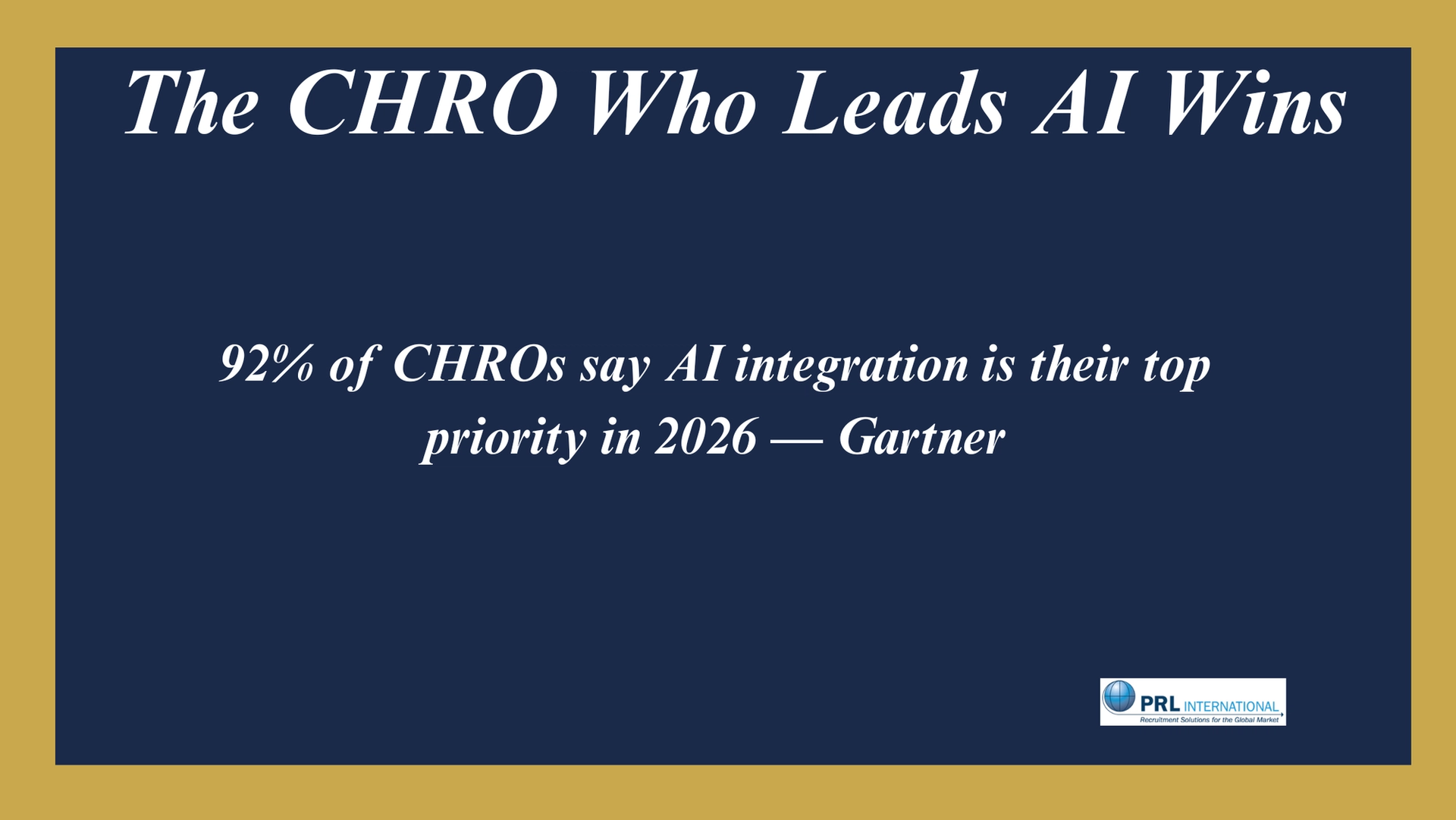
Here is what the shift looks like in numbers. Ninety-two percent of CHROs anticipated that AI would be further integrated into the workforce in 2026, and 87 percent forecast greater AI adoption within HR processes specifically. Growth and market expansion have increased as a stated CHRO priority by 25 percent over the past two years. More than one third of CHROs globally now spend the majority of their time leading transformation efforts rather than managing operations. Those are Gartner's numbers, not projections. They describe what is already happening inside companies that are getting ahead of this.
The companies not getting ahead of it are treating AI as a technology initiative owned by the CTO or the IT function. That approach is producing the results McKinsey documented in its State of AI 2025 report: 78 percent of organizations now use AI in at least one business function, but only one third report scaling it across the organization. The gap between adoption and scaled value creation is precisely where the CHRO either earns the company a competitive advantage or costs it one.
In more than 30 years of retained search placing senior leaders in mid-market manufacturing, energy, and business services companies across Pittsburgh and Western Pennsylvania, the searches that produce the most consequential hires are the ones where the client has updated their definition of the role before the search begins. The CHRO search is now the most urgent example of that requirement.
What Should a 2027 CHRO Job Description Include?
A 2027 CHRO job description should include six responsibilities that did not appear in the 2019 version: skills-based workforce design, AI value realization across the workforce, decisions about which roles get filled or redesigned or automated, a reskilling strategy built rather than inherited, compensation restructured around new behaviors, and a learning culture that sustains AI adoption over time.
Most CHRO job descriptions still in circulation were written for a role that no longer exists. They describe an executive who administers programs. The role now designs the organization. The table below is the comparison we walk clients through before a search brief goes out, because a search run against the left column will surface a very different candidate than one run against the right.
| Responsibility | The 2019 CHRO job description | What 2027 requires |
|---|---|---|
| Workforce planning | Headcount forecasting and succession planning | Skills-based workforce design across human and AI work |
| Technology | Partner with IT on the HRIS selection | Own AI value realization across the workforce |
| Talent acquisition | Build and manage the recruiting pipeline | Decide which roles get filled, redesigned, or automated |
| Learning and development | Training calendars and compliance | Reskilling strategy for the 40 percent of workers the World Economic Forum expects to need it within three years |
| Compensation | Market benchmarking and the annual merit cycle | Restructure rewards around the behaviors the new organization requires |
| Culture | Engagement surveys and retention programs | Build a learning culture that sustains AI adoption over time |
If you are writing this description for a company that is deploying AI agents rather than only AI tools, the requirements tighten further. Our AI and agentic intelligence practice covers what changes when the workforce includes agents.
Why Is the CHRO Now the Executive Who Determines Whether AI Creates Value or Just Cost?
The CHRO is now the executive who determines whether AI creates value or just cost because the gap between AI adoption and scaled AI value creation is a workforce design problem, not a technology problem, and workforce design is the CHRO's domain.
IBM published a detailed analysis in Fortune magazine in April 2026 making this argument directly: today's CHROs are not stewards of policy and process. They are architects of how work is designed, how skills are developed, and how enterprise value is created through people. The CHRO's primary challenge in an AI-first organization is to orchestrate the human-plus-AI workforce.
The strength of an organization is determined not by its technology but by the people who decide how that technology is used.IBM Institute for Business Value, 2025
That is not a function any other executive can perform. The CTO does not own workforce design. The CFO does not own skills development at scale. The CEO does not have the bandwidth to lead reskilling across the organization while running the business. The CHRO either owns this or it does not get owned.
Deloitte's 2025 Global Human Capital Trends report identified the structural reason this is so difficult. Traditional workforce planning starts with jobs. AI demands starting with skills. As AI absorbs routine tasks, the higher-value work becomes clearer. Analysts shift from data gathering to insight generation. HR partners shift from transactional processing to coaching leaders and identifying workforce trends. Every function reorganizes around what humans do better than machines.
The executive who redesigns that organization is the CHRO. And the CHRO who cannot think that way is not the CHRO a mid-market company needs in 2027.
SHRM's State of AI in HR 2026 report confirmed that organizations are now actively seeking CHROs who can both up-skill their people and create cultures of learning that sustain AI adoption over time. That is a strategic leadership capability, not an HR administration capability. The profile of the role has permanently changed, and the search process has to change with it.
What Cognitive Profile Does a CHRO Need to Lead an AI-First Workforce?
The cognitive profile a CHRO needs to lead an AI-first workforce centers on Strategic Thinking, not Relationship Building or Executing, which drove CHRO hiring decisions for most of the last two decades.
Gallup's four leadership domains are Executing, Influencing, Relationship Building, and Strategic Thinking. For most of the last two decades, CHRO searches weighted heavily toward Relationship Building and Executing. Build the culture. Run the process. Keep the people. Those were the right priorities for an era where HR was fundamentally operational.
The Strategic Thinking domain is what the role now requires. Gallup describes executives who lead with the Strategic theme as people who see patterns where others see complexity, create alternative ways to proceed before problems arrive, and maintain a clear picture of the desired outcome regardless of the obstacles between here and there. They anticipate rather than react.
That is exactly the cognitive profile a company needs in a CHRO who is simultaneously managing workforce design, AI integration, reskilling strategy, and talent acquisition in a market where 40 percent of workers globally will need to reskill in the next three years due to AI, according to the World Economic Forum. A CHRO who leads with Strategic is likely to have already built the plan before the conversation starts. A CHRO who leads primarily with Executing and Relationship Building is likely to respond well, but respond is not lead.
In the searches our firm has run over the past 18 months, the language in hiring briefs has shifted. The asks are no longer about HR expertise alone. They are about organizational architecture, AI readiness, and workforce transformation strategy. The clients getting ahead of this are adding StrengthsFinder assessments to their CHRO evaluation process specifically to identify whether the candidate leads with Strategic or whether they lead with Executing and Relationship Building in a role that now demands all three, but Strategic above all.
PRL International is a retained executive search firm serving Pittsburgh and Western Pennsylvania, specializing in senior-level placements in mid-market companies across manufacturing, energy, and business services.
What Does a Mid-Market CHRO Search Look Like When the Role Has Changed This Much?
A mid-market CHRO search that accounts for the AI shift looks different from a traditional CHRO search in three specific ways: the candidate profile, the evaluation criteria, and the reference process.
The candidate profile now includes demonstrated experience with workforce redesign around AI or automation, not just HR program management. This does not require a CHRO who is a technologist. It requires a CHRO who has managed through a significant technology-driven workforce transition and can articulate what they changed, why they changed it, and what the organization looked like on the other side. That is a fundamentally different conversation than reviewing years of HR experience.
The evaluation criteria shift toward evidence of transformation leadership. The best CHROs for this moment have a specific example of a skills-based workforce redesign they led, a reskilling initiative they built from scratch rather than inherited, and a compensation restructure that realigned rewards with the new behaviors the organization needed. Those are the dimensions that predict success in the role as it currently exists. Behavioral interviews built around traditional HR competencies will surface the wrong candidate every time.
The reference process must include at least one former CEO who can speak to whether this candidate challenged assumptions about how work should be organized, not just whether they ran HR effectively. The CHRO who is going to lead AI value realization in a mid-market company has a track record of pushing leadership teams to think differently about what work is and who should do it. A peer reference does not surface that. A former CEO who worked directly with the candidate at the strategic level does.
Gallup has documented that companies whose employees are highly engaged outperform peers by 23 percent in profitability. Add a CHRO who is actively designing the human-AI workforce strategy and the performance gap compounds. The companies that land this hire right in 2027 are positioning themselves for a multi-year advantage that competitors will spend years trying to close.
For a complete picture of how the CHRO hire connects to overall mid-market leadership strategy, read how to hire a CHRO who actually changes company culture and why the CHRO is your most undervalued executive. For guidance on building the search the right way before the first call goes out, read what retained executive search actually looks like and visit our mid-market executive search overview.
Common questions
- What Should a 2027 CHRO Job Description Include?
- A 2027 CHRO job description should include six responsibilities that did not appear in the 2019 version: skills-based workforce design, AI value realization across the workforce, decisions about which roles get filled or redesigned or automated, a reskilling strategy built rather than inherited, compensation restructured around new behaviors, and a learning culture that sustains AI adoption over time.
- Why Is the CHRO Now the Executive Who Determines Whether AI Creates Value or Just Cost?
- The CHRO is now the executive who determines whether AI creates value or just cost because the gap between AI adoption and scaled AI value creation is a workforce design problem, not a technology problem, and workforce design is the CHRO's domain.
- What Cognitive Profile Does a CHRO Need to Lead an AI-First Workforce?
- The cognitive profile a CHRO needs to lead an AI-first workforce centers on Strategic Thinking, not Relationship Building or Executing, which drove CHRO hiring decisions for most of the last two decades.
- What Does a Mid-Market CHRO Search Look Like When the Role Has Changed This Much?
- A mid-market CHRO search that accounts for the AI shift looks different from a traditional CHRO search in three specific ways: the candidate profile, the evaluation criteria, and the reference process.